
Attic Mold Removal in Temple City, CA
Temple City’s post-war ranch homes are the San Gabriel Valley’s workhorses — solid, unpretentious, and sitting on 1950s ventilation that’s been quietly failing for decades.
Call (877) 860-8345 — free inspection
Most Temple City homeowners never think about the attic until a musty smell, a ceiling stain, or a home inspector’s note forces the issue. If that’s where you’re at, here’s what actually causes attic mold in Temple City specifically, and what to do about it.
Why Temple City Homes Get Attic Mold
Direct answer: 1940s–1960s ranch and tract homes with original or aging ventilation — bath fans venting into attics (standard when these homes were built), no ridge vents, gable vents sealed during energy retrofits — plus mature camellia-era landscaping holding moisture against eaves and rooflines, and flat-terrain storm drainage that pools around foundations during heavy winter sequences.
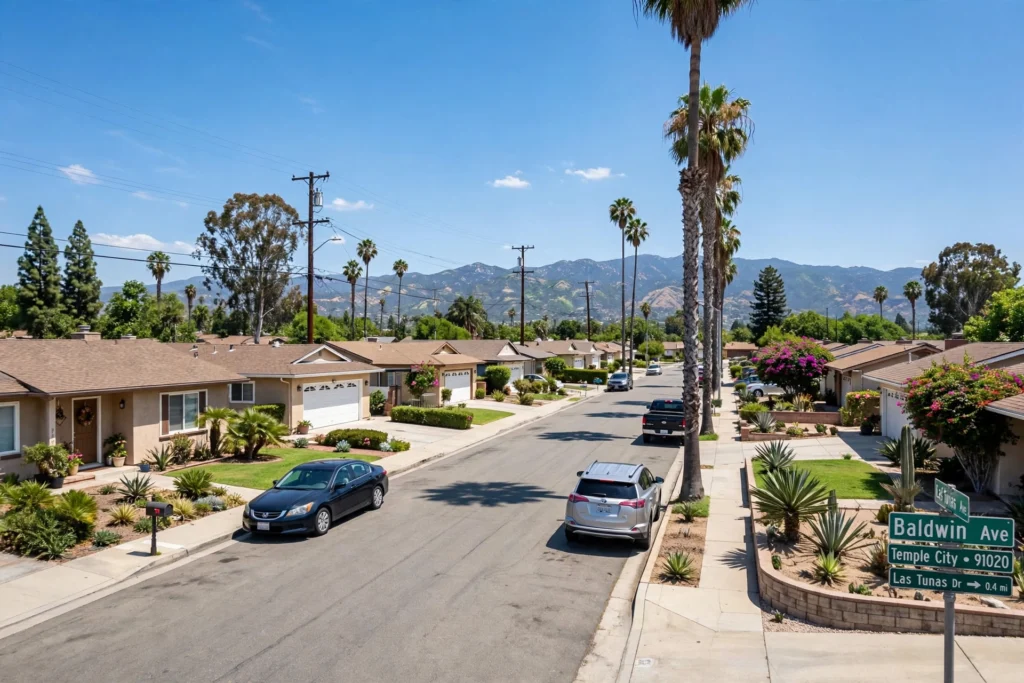
The housing stock defines everything here. Temple City boomed after WWII, and the ranch homes along Las Tunas Drive and through the residential tracts went up fast — with ventilation that met 1950s code and hasn’t been touched since. The classic Temple City attic has blown insulation piled over the original vents, a bathroom fan dumping shower steam straight into the rafters, and a roof that’s been re-shingled twice without anyone ever checking whether the attic can breathe. It’s not neglect — it’s just what happens when a house outlives its original systems by seventy years.
The landscaping is the quiet second factor. Temple City calls itself the “Home of Camellias,” and the mature plantings are genuinely beautiful — but decades-old shrubs and trees crowd the eaves of countless homes here, shading the roof edge and holding moisture against fascia and soffits. Where branches touch the roof, organic debris collects in the exact spots where flashing needs to stay clean and dry.
And the flat terrain has its own quirk. Without hillsides to shed water, Temple City’s winter storm sequences pool around foundations — and homes without modern drainage or vapor barriers wick that moisture upward through the whole structure. The attic is the last place it shows, but show it does: north-facing decking that never fully dries between storms.
Signs Your Temple City Attic May Have Mold
You don’t need to climb up there yourself — but these are the things that tell us an inspection is warranted:
- A musty smell on the top floor or near the attic access, especially after rain or during marine-layer mornings
- Dark staining on roof decking or rafters — visible if you poke your head through the hatch with a flashlight
- Water stains on upstairs ceilings, which almost always trace back to something happening above them
- Bathroom exhaust fans that vent into the attic instead of through the roof — extremely common in Temple City’s post-war ranch homes, and a slow-motion moisture pump
- Vegetation touching the roof or eaves — mature landscaping holding moisture against the roofline
- A roof that’s been re-shingled without ventilation upgrades — new shingles over a suffocating attic just hides the problem longer
One honest note: staining isn’t always mold, and mold isn’t always visible. That’s what the attic mold inspection is for — confirming what’s actually there before anyone talks about remediation.
What a Temple City Attic Mold Inspection Covers
Direct answer: a full walk of the attic (where accessible), moisture readings on decking and rafters, identification of the moisture source, and a written report with photos — free, whether or not you hire us for anything further.
In Temple City specifically, we pay extra attention to four things: bath fan terminations in post-war ranch homes (the number-one finding), whether insulation upgrades buried the original vents, vegetation contact at eaves and rooflines, and moisture patterns suggesting foundation-up wicking after storm sequences. The written report is yours to keep — shop it around, get a second quote, use it with your contractor. An inspection that pressures you into same-day remediation isn’t an inspection; it’s a sales call.
Attic Mold Removal Cost in Temple City
Direct answer: for a typical Temple City home in 2026, professional attic mold remediation runs $500 to $10,000+, with most residential jobs landing between $1,500 and $4,000 — the same ranges as Pasadena, since the housing stock and labor market are essentially the same. Temple City’s ranch homes tend toward straightforward rectangular attics, which keeps most jobs on the simpler (and cheaper) end.
- Spot treatment ($500 – $1,500): small, accessible area; no insulation replacement
- Moderate remediation ($1,500 – $4,000): multiple areas; containment; partial insulation removal
- Extensive remediation ($4,000 – $10,000+): widespread growth; full insulation replacement; ventilation corrections
Temple City-specific cost drivers: deep layered insulation from multiple top-ups over the decades costs meaningfully more when it’s gone wet and must be removed; and jobs where the fix includes proper bath-fan rerouting through the roof (not just remediation) add a half-day of work — worth it, since skipping it guarantees a callback. Full breakdown of what drives the price: our 2026 Pasadena-area cost guide.
What Happens When You Call
Direct answer: the same two-step process we use everywhere in the service area — an attic mold inspection to confirm what’s actually there and what’s causing it, followed by remediation and removal if active growth is confirmed.
We don’t quote remediation sight unseen over the phone — every job in Temple City starts with an in-person look at the attic, not a guess. If the inspection finds nothing active, we’ll tell you that too. We’d rather earn a customer for life than sell a job that isn’t needed.
Keeping Mold Out of Your Temple City Attic
After remediation — or if your inspection comes back clean and you want to keep it that way:
- Vent bath fans through the roof, not into the attic. In Temple City’s ranch homes, this is the single highest-ROI fix.
- Trim vegetation back from eaves and rooflines. The camellias can stay — just not touching the roof.
- Don’t let a re-roof seal your soffit vents. We’ve seen this repeatedly across the San Gabriel Valley: new roof, sealed vents, condensation mold a year later.
- After any roof work — re-shingling, patching, flashing repair — check the attic once the work is done, not next year.
- Watch the winter storm sequences. The mold that appears in February often started with December’s storms — and flat-terrain pooling makes it worse.
More on this: attic mold prevention for Pasadena-area homes.
Temple City Attic Mold FAQs
Q: Do you actually serve Temple City, or is this just a landing page?
A: We serve Temple City directly as part of our regular San Gabriel Valley service area — it’s not a lead-gen redirect to someone else. Temple City sits right between Arcadia and San Gabriel, minutes from Pasadena, which changes nothing about the work itself.
Q: My ranch home was built in the 1950s — is the attic even worth inspecting?
A: Especially then. Seventy-year-old ranch attics are where we find the most predictable mold in the Valley: original bath-fan venting into the attic, insulation buried over dead vents, and re-roofs that never addressed ventilation. Age isn’t the problem — unmaintained original systems are.
Q: How much does an inspection cost?
A: Our inspection is free, full stop — whether or not you hire us for remediation. If you want a standalone paid inspection purely for documentation (e.g., a transaction file), that’s typically $250–$500 in this market.
Q: How much will remediation cost for my Temple City home?
A: Most residential jobs land between $1,500 and $4,000; Temple City’s straightforward ranch attics often land on the simpler end. The honest answer for your specific attic comes from the free inspection, not a webpage. See the cost section above or the full 2026 cost guide for what drives the number up or down.
Q: How fast can someone come out to Temple City?
A: Scheduling depends on current volume, but most Temple City inspections are booked within the same week — call (877) 860-8345 for the next available slot.
Q: There’s no mold license in California — so how do I know the work is legitimate?
A: Correct — California has no state mold license, so anyone can print “certified” on a business card. Judge by the process instead: a real inspection with moisture readings and photos, an itemized written scope, containment and negative air during the work, and the moisture source fixed — not just fogged. If a quote is one line with no breakdown, get a second one.
See all the areas we serve or read the full attic mold removal guide. Questions first? Contact us.
Pasadena Attic Care — free inspection, honest scope, no scare tactics.
📞 Call (877) 860-8345
Hours: Mo,Tu,We,Th,Fr,Sa,Su 09:00-17:00
Serving Pasadena & the San Gabriel Valley | (877) 860-8345