
Attic Mold Removal Services in Pasadena, CA
The attic is the one part of a Pasadena home almost nobody checks until a home inspector, a musty smell, or a ceiling stain forces the issue. This page covers why that happens here specifically, what a real inspection and remediation actually involve, what it costs, and what California law requires if mold turns up while you are selling.
No two attics fail the same way, but the pattern in Pasadena is consistent enough to name: warm, moist household air rises into a roof cavity that was framed before modern ventilation codes existed, meets a cold roof deck on a cool Pasadena night, and condenses. Add the organic material every roof deck is made of and the mold spores already present in ordinary air, and growth is a matter of weeks, not years. Everything below explains that mechanism in more depth, plus what fixing it actually costs and involves.
Why Pasadena Attics Are Different From a Textbook Attic
Most articles about attic mold are written for a generic house in a generic climate. Pasadena is not that. The city sits directly against the San Gabriel Mountains, which means hillside neighborhoods deal with hydrostatic pressure and runoff that flatland neighborhoods never see, while the marine layer that drifts in from the coast keeps overnight humidity higher than the dry-desert reputation of Southern California would suggest. A roof deck in Bungalow Heaven or Garfield Heights cools overnight in a way that surprises people who assume mold is a rainy-climate problem.
Housing stock matters just as much as climate. A large share of Pasadena’s homes, in Bungalow Heaven, Old Pasadena, San Rafael, Linda Vista, and Madison Heights, are Craftsman bungalows and California Arts and Crafts-era houses framed in the early 1900s through the 1930s, decades before soffit and ridge venting was a code requirement. Hillside homes along the Arroyo Seco add a second variable: grading and drainage that was never designed around today’s insulation standards. Newer construction in Hastings Ranch generally ventilates better, but even there, a bathroom fan vented straight into the attic instead of through the roof can undo a well-built roof system in a single humid season.
What Actually Causes Mold to Grow in a Pasadena Attic?
Direct answer: mold needs moisture, an organic food source, and time, and a poorly ventilated attic supplies all three without anyone noticing. Warm, humid air from inside the living space rises into the attic through can lights, attic hatches, and gaps around plumbing and wiring penetrations. If soffit and ridge vents are not working together to keep that air moving, it hits the cold underside of the roof deck, reaches its dew point, and condenses into standing moisture on wood that already has organic material and airborne mold spores present. The EPA’s standard guidance is that wet material left more than 24 to 48 hours is enough time for growth to begin, which is why a single bad rainy season, or a leak that goes unnoticed over a few closed-up weeks, is often all it takes.
Three specific installation problems account for most of what we would expect to find in an older Pasadena attic: soffit vents that were painted over, insulated over, or never cut through during a remodel, so intake air has nowhere to enter; a bathroom or dryer exhaust fan that terminates inside the attic instead of running through an insulated duct straight out the roof, which dumps household humidity directly where it does the most damage; and blocked or missing ridge ventilation, so even a working soffit vent has nowhere for the rising warm air to exit. Any one of these can turn a structurally sound attic into a recurring mold problem.
How Do I Know If My Attic Actually Has a Mold Problem?
Direct answer: the most common first sign is a musty smell that is stronger near an attic hatch or upstairs closet than anywhere else in the house, followed by visible dark, gray, or greenish staining on the roof deck or rafters if you look up into the attic with a flashlight. A simple check anyone can do without going up top: on a sunny day, look up at your soffit vents from underneath the eaves. If you cannot see daylight through them, they are painted shut, insulated over, or were never cut in the first place, which is a strong sign the attic is not ventilating the way it should. Other signs include a ceiling stain that keeps reappearing after painting, higher-than-expected allergy symptoms that ease when you are away from the house, and, most often, a home inspector or appraiser flagging it during a sale.
The Craftsman, Bungalow, and Hillside Homes That Make This a Pasadena-Specific Problem
A Craftsman bungalow built in the 1910s or 1920s was framed around wood shingle or shake roofing, gravity ventilation, and building science that predates the moisture-barrier and vent-ratio standards used today. Many of these homes still have their original roof framing, which means the attic space was never designed with a soffit-to-ridge ventilation ratio in mind at all, let alone one that meets current code. Knob-and-tube-era wiring penetrations, since sealed or rerouted in most homes, left gaps in the ceiling plane that let warm, moist air migrate into the attic more easily than a modern, properly air-sealed ceiling would allow.
Hillside homes along the Arroyo Seco and in the upper elevations near the San Gabriel foothills add hydrostatic pressure and runoff to the equation. Grading that was adequate when a home was built decades ago does not always account for how water moves during a modern Southern California downpour, and a slow foundation or roof leak on a hillside lot can feed moisture into an attic space for months before anyone notices a stain. Homes with vermiculite insulation, common in Pasadena’s older housing stock and sometimes recognizable by its gold, flaky, “fool’s gold” appearance, carry an additional consideration: some vermiculite installed before the 1990s may contain asbestos, and the EPA recommends against disturbing it without proper handling. If your attic has this kind of insulation, that gets addressed before any mold work begins, not incidentally during it.
What Does Attic Mold Removal Actually Involve, Step by Step?
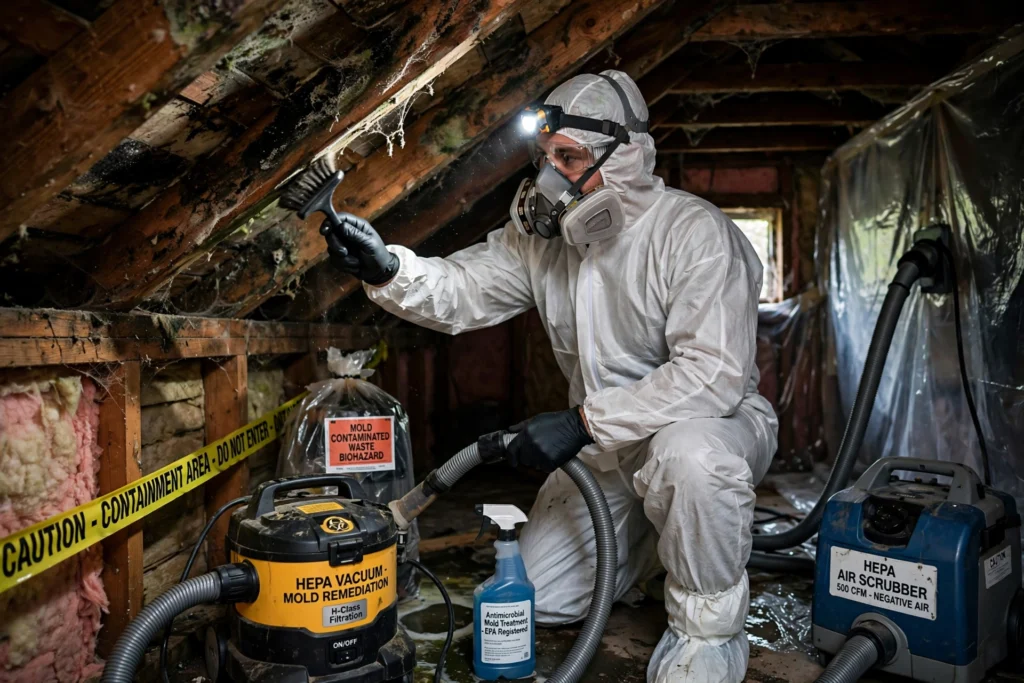
Direct answer: a real attic mold job is inspection first, containment second, removal third, and verification last, not a single visit where someone sprays something and leaves. Reputable mold contractors generally follow the framework laid out in the IICRC S520 standard, the industry reference for mold remediation in the United States, which is built around isolating the problem before disturbing it, removing what cannot be cleaned, treating what can, and confirming the result with independent testing rather than a visual check alone.
- Inspection. A physical walk-through of the attic space, not just a look through the hatch, checking the roof deck, rafters, insulation, and any ductwork for staining, moisture, and active growth, with a moisture meter to confirm what is still wet versus what dried out on its own.
- Sampling and scoping. Where growth is found, a surface tape lift, swab, or air sample confirms what is actually there before any work is scoped, so the plan is based on evidence and not a guess.
- Containment. The attic access point is sealed off with physical barriers before anything is disturbed, so spores do not spread into the living space through the hatch or recessed light fixtures during the work.
- HEPA filtration and negative air pressure. Air scrubbers pull air through HEPA filtration and keep the work area under negative pressure relative to the rest of the house, so airborne spores are captured rather than pushed into the hallway below.
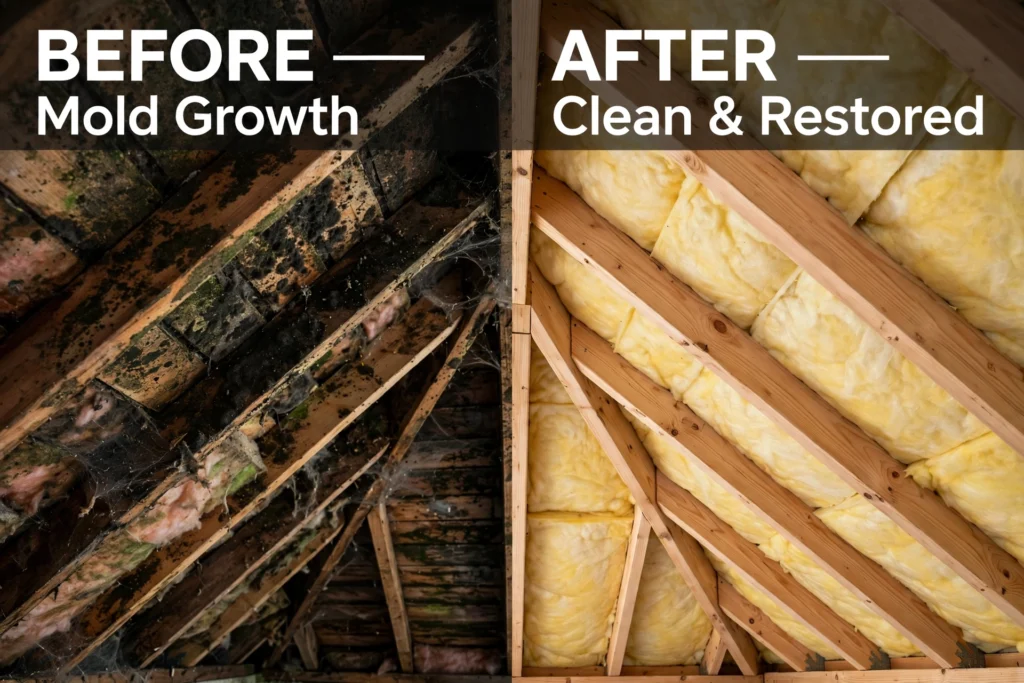
- Removal and treatment. Contaminated insulation and any wood that cannot be cleaned is removed and bagged for disposal; roof deck and rafter surfaces that can be saved are HEPA vacuumed, treated with an antimicrobial or biocide, and, where staining remains after the mold itself is dead, treated again to address the discoloration.
- Fixing the actual cause. Removal without correcting the ventilation, the mis-routed exhaust fan, or the leak that caused it in the first place is treating a symptom. This is the step that determines whether the problem stays gone.
- Clearance testing. A third-party air or surface sample, ideally from a lab not affiliated with the company that did the work, confirms spore counts are back to a normal background level before the job is considered complete.
That last step is worth pausing on, because it is also the answer to one of the most common questions we hear: why does attic mold sometimes come back after it was supposedly removed? In almost every case we would expect to see, the mold itself was cleaned or removed, but whatever was feeding it, the blocked vent, the mis-routed fan, the slow leak, was never fixed. Bleach or a surface treatment kills what is visible. It does not fix a soffit vent that is still painted shut. Finding and correcting the actual moisture source is what makes a fix permanent instead of a job you repeat every year or two.
How Much Does Attic Mold Removal Cost in Pasadena?
Direct answer: most attic mold jobs run somewhere between $1,000 and $4,000, with a small, easily accessed spot on the low end and a large attic with insulation replacement, extensive staining, or a persisted, longstanding problem pushing toward the higher end or beyond. Industry pricing data for attic-specific treatment consistently lands in the $1,150 to $3,000 range for a typical job billed by square footage, which lines up closely with the broader range above. Nobody in this market publishes real numbers, so treat any quote that seems dramatically outside this range, in either direction, as worth asking follow-up questions about.
| What drives the cost | Lower cost | Higher cost |
|---|---|---|
| Attic size | Small, under 500 sq ft | Large, 1,500+ sq ft |
| Accessibility | Full-height, easy hatch access | Low-clearance, tight or multiple access points |
| Extent of growth | Localized spot, caught early | Widespread, longstanding, multiple areas |
| Insulation | Salvageable, can be treated | Contaminated, needs full removal and replacement |
| Root cause fix | Vent already functional | Ventilation rework, duct rerouting, or leak repair needed |
Figures reflect typical ranges reported across attic-specific mold remediation pricing data as of 2026 and are not a quote for your specific attic. Every job is scoped after an inspection, not before one.
What Kind of Mold Actually Grows in an Attic?
Most competitor sites in this market talk about “black mold” as if it were a single species. It usually is not. Stachybotrys chartarum, the species most people mean when they say black mold, does grow in water-damaged wood and is one possibility, but attic growth is commonly one of several more frequently occurring genera: Aspergillus, Penicillium, Cladosporium, Alternaria, and, less often, Chaetomium or Trichoderma. Color alone does not tell you which one you are looking at, and dark staining can come from mold, from mildew, or simply from oxidized wood. Species identification through lab sampling, not a visual guess, is the only way to know for certain what you are dealing with, and it is one of the reasons a real inspection includes sampling rather than a flashlight and an opinion.
Is Attic Mold Actually Dangerous, or Is “Toxic Black Mold” Overblown?
Direct answer: for most healthy adults, mold exposure causes the reactions the CDC documents: nasal and sinus congestion, a sore or scratchy throat, coughing or wheezing, and eye or skin irritation. People with asthma, mold allergies, or compromised immune systems can react more severely, including a documented risk of hypersensitivity pneumonitis or fungal infection in immunocompromised individuals. The “toxic black mold” framing that shows up across a lot of competitor content overstates this for most households. Color alone does not indicate whether a mold is producing mycotoxins, and species identification through testing, not a Google Image search, is the only reliable way to know what risk level you are actually dealing with. We would rather give you the accurate version than the scary one.
That said, an attic problem does not always stay in the attic. Shared airspace through the ceiling plane, an HVAC return duct that runs through the attic, or a poorly sealed attic hatch can all move spores into rooms below over time, which is part of why a musty smell or unexplained allergy symptoms are worth investigating even when nothing is visibly wrong downstairs.
Areas We Serve Around Pasadena
Coverage extends across Pasadena’s neighborhoods, Bungalow Heaven, Garfield Heights, Old Pasadena, San Rafael, Linda Vista, Madison Heights, and Hastings Ranch among them, along with the immediate San Gabriel Valley: South Pasadena, Altadena, San Marino, Arcadia, Sierra Madre, Temple City, and Glendale. Craftsman bungalows, hillside homes along the Arroyo Seco, and newer construction all get the same inspection-first approach, adjusted for what that specific type of house is actually prone to.
Do I Need to Disclose Attic Mold When Selling My Pasadena Home?
Direct answer: yes, in most cases. Under California Civil Code Section 1102.6, sellers of one-to-four-unit residential property must disclose known mold contamination and past water damage on the Transfer Disclosure Statement, and this applies even to mold that has already been remediated. California Health and Safety Code Section 26147 separately requires written disclosure when mold is present at a level that poses a health threat. Buyers who discover non-disclosure after closing have up to two years to sue, and exposure can include rescission of the sale, not just damages. If a pre-listing inspection finds attic mold, addressing it and documenting the remediation before it goes on the market is generally the more straightforward path than disclosing an unresolved problem and letting a buyer’s inspector find it during escrow. This is general information, not legal advice; for a transaction-specific question, a real estate attorney is the right call.
Who Wrote This Page
This page was written and is maintained by the pasadenaatticmoldremoval.com team, built specifically around attic-mold remediation for Pasadena and the San Gabriel Valley rather than as one service line inside a general water-damage or restoration business. Every technical claim here is checked against CDC and EPA guidance and the IICRC S520 industry standard, and every California legal citation is checked against the actual statute text, not secondhand summaries. This page is reviewed periodically and updated when guidance changes; if you find something outdated, we would want to know.
A Few More Questions We Hear Often
How long does an attic mold job actually take?
A localized spot can be inspected, treated, and cleared in a single day. A larger job involving insulation removal, containment, and third-party clearance testing more commonly runs two to four days, since the clearance sample needs lab turnaround time before the job is signed off as complete.
Will I need to leave my house during the work?
Usually not for the whole job, but you may be asked to stay out of the immediate work area, and sometimes the house itself, during active containment and removal. This is standard practice, not a red flag. Reputable contractors do not want to be responsible for anyone breathing disturbed spores during the most active phase of the work.
Does homeowners insurance cover attic mold removal?
Usually only if the mold resulted from a sudden, covered event, like a burst pipe or storm damage, rather than a gradual leak or long-term poor ventilation. Most standard policies exclude mold from deferred maintenance or slow-developing moisture issues, which is worth confirming with your carrier directly before assuming coverage either way.
Not Sure Whether What You’re Seeing Is Actually a Problem?
A real inspection settles it either way. Call and describe what you’re seeing, or request a callback and we’ll get back to you.